
GEO for Singapore SMEs: How to Get Your Business Cited by ChatGPT and Google AI Overviews
Short answer: Generative Engine Optimization (GEO) is the practice of structuring your website so AI tools like ChatGPT, Google AI Overviews, Gemini and Perplexity name your business when someone asks them a question. For a Singapore SME, the work is surprisingly affordable — it’s mostly clean content, FAQ-style answers, accurate business listings and schema markup. You don’t need a big budget. You need to start before your competitors do.
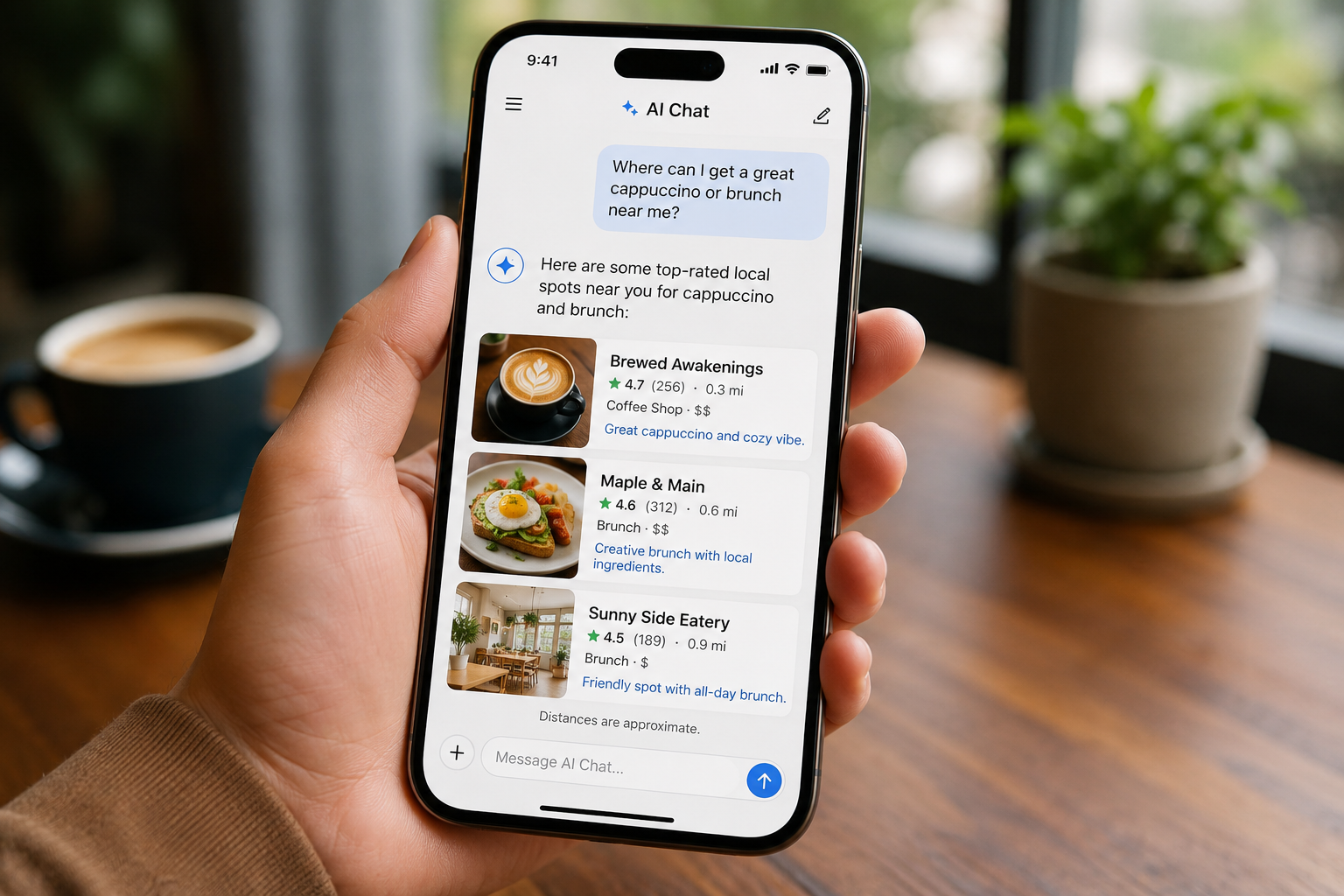
For twenty years, getting found online meant one thing: ranking on the first page of Google. That’s changing fast. Today, a customer looking for an aircon servicing company in Bukit Merah, a dentist in Tampines, or a caterer for an office event increasingly skips the list of blue links entirely. They ask ChatGPT or read Google’s AI Overview, and they act on the handful of names the AI mentions.
If your business isn’t one of those names, you’re invisible — even if you still rank well on traditional Google. This post explains what GEO is, why it matters for small businesses in Singapore, and seven things you can do this month to start showing up in AI answers.
What is GEO, and how is it different from SEO?
SEO (Search Engine Optimization) is about earning a high position in a list of search results so people click through to your site. GEO is about becoming part of the answer itself — the source an AI cites or recommends when it replies in plain language.
Here’s the good news: the two are not rivals. Google’s own 2026 guidance treats optimizing for its AI features as still being SEO, and most practitioners agree the large majority of GEO is simply solid, fundamental SEO done well. If you’ve already invested in clean content, fast hosting and proper structure, you have a head start. GEO just adds a few new habits on top.
The difference is in the goal:
- SEO success = rankings and clicks to your website.
- GEO success = being cited as a trusted source inside an AI-generated answer, even when the user never visits your site.
Why Singapore SMEs can’t ignore this in 2026
The shift is being driven by sheer usage. ChatGPT reached more than 900 million weekly active users by early 2026, and Google’s AI Overviews now appear on roughly a fifth of all searches — with far higher rates for local and “how do I find a good…” style questions, exactly the queries that bring in SME customers. Industry analysts at Gartner have projected traditional search volume could fall by around 25% by 2026 as people lean on AI assistants instead.
For a small business, that’s both a threat and an opening. The threat: if buyers research on AI and you’re absent, you lose them before they ever hear your name. The opening: AI search is still new, most local competitors haven’t optimized for it, and the things that move the needle are largely within your control.
That last point matters. One large study of millions of AI citations found that the bulk of them come from sources a business can manage directly — its own website and its business listings — rather than expensive media coverage. Another analysis found that adding structured data and clear “entity” information measurably increased how often small brands appeared in AI answers. In a narrow, local category, being well-organised beats being big.
7 practical steps to start showing up in AI answers
1. Front-load the answer on every key page
AI tools that pull live information (Google AI Overviews, Perplexity) heavily weight the opening of a page. Don’t bury your point. The first paragraph of each service page and blog post should answer the core question directly — what you do, who you serve, where, and roughly what it costs — before you elaborate. Notice this very article opens with a one-line answer.
2. Write in a question-and-answer format
AI assistants are answering questions, so content shaped like questions gets extracted more easily. Add a genuine FAQ section to your homepage and service pages: “How much does a website cost in Singapore?”, “Do you provide after-sales support?”, “How long does an e-commerce build take?” Answer each in two or three clear sentences.
3. Add schema markup (this is the technical edge)
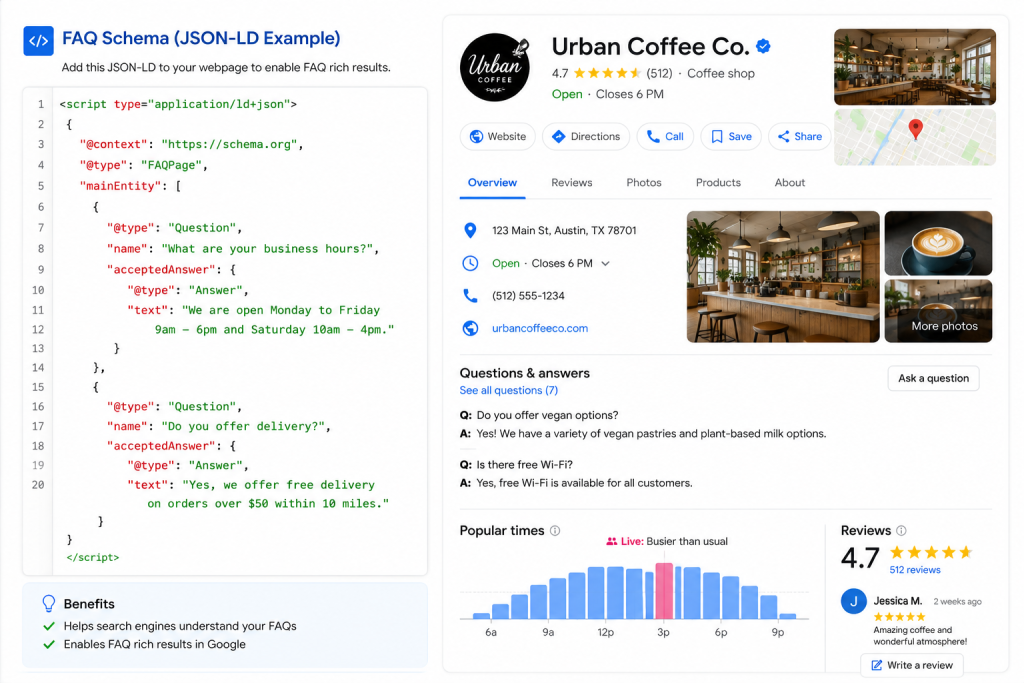
Structured data is code that tells search engines and AI exactly what your business is — your name, address, services, opening hours and FAQs — with no guesswork. Studies have linked proper schema to noticeably higher visibility in AI-generated answers. At minimum, every local SME site should have LocalBusiness schema and FAQPage schema. (We’ve included ready-to-use schema for this very post below.)
4. Get your business listings consistent and complete
A huge share of AI citations come from business listings, not just your website. Make sure your Google Business Profile is complete and accurate, and that your name, address and phone number match exactly across every directory — Google, local Singapore listings, and industry directories. Inconsistent details confuse AI and cost you mentions.
5. Use real numbers, sources and specifics
Research into what AI engines cite consistently found that adding statistics, citations and quotable facts lifts the chances of being referenced. Vague marketing language (“we deliver world-class solutions”) gets ignored. Concrete detail (“we’ve built over 600 websites for Singapore SMEs since 2016, typically delivered in 2–3 weeks”) gets cited.
6. Keep your content fresh
AI systems, especially Perplexity, strongly favour recently updated content — often within the last few months. A blog that hasn’t moved since 2019 signals neglect. Even light, regular updates to your top pages help keep you in the running.
7. Test it yourself — then track it
Open ChatGPT, Gemini and Perplexity and ask the questions your customers would ask: “Who are some affordable web design agencies in Singapore for small businesses?” Note whether you appear, how you’re described, and which sites get cited. Re-check monthly. As of early 2026 there’s no way to pay for placement in AI answers — every citation is earned — so this free testing loop is your real scoreboard.
The honest bottom line
GEO is not a magic replacement for SEO, and Google still sends far more traffic than all AI tools combined today. But the direction is clear, the early movers are getting cited, and the groundwork — clean content, accurate listings, good schema — is the same groundwork that makes your traditional SEO stronger anyway. For a Singapore SME, there’s very little downside to starting now and a real cost to waiting.
If sorting out schema, listings and AI-ready content sounds like more than you want to take on, that’s our day job. Talk to us about SEO and AI search visibility — we’ve been helping Singapore small businesses get found since 2016.
Frequently Asked Questions
What is generative engine optimization (GEO)?
GEO is the practice of structuring and writing your website content so AI search tools — ChatGPT, Google AI Overviews, Gemini, Perplexity and Claude — cite or recommend your business when answering a user’s question. It focuses on becoming part of the AI’s answer, not just ranking in a list of links.
Is GEO the same as SEO?
No, but they overlap heavily. Most of GEO is good, fundamental SEO — clean content, authority and technical health. GEO adds a layer focused on direct-answer formatting, structured data and citation-worthy detail. Businesses with strong SEO foundations tend to see GEO results fastest.
Do small businesses in Singapore really need GEO?
Increasingly, yes. AI tools now handle a large and growing share of “find me a good…” searches, including local ones. Because most small competitors haven’t optimized for AI yet, an SME that gets the basics right can win visibility well above its size.
Can I pay to appear in ChatGPT or Google AI Overview answers?
No. As of early 2026, no major AI platform offers paid placement inside generated answers. Citations are earned through content quality, accurate business information, structured data and trust signals.
How long does GEO take to work?
Tools that read the live web (Google AI Overviews, Perplexity) can reflect changes within a few weeks of updating your content and schema. Building durable authority takes longer, but the foundational fixes show up quickly.
Comments are closed